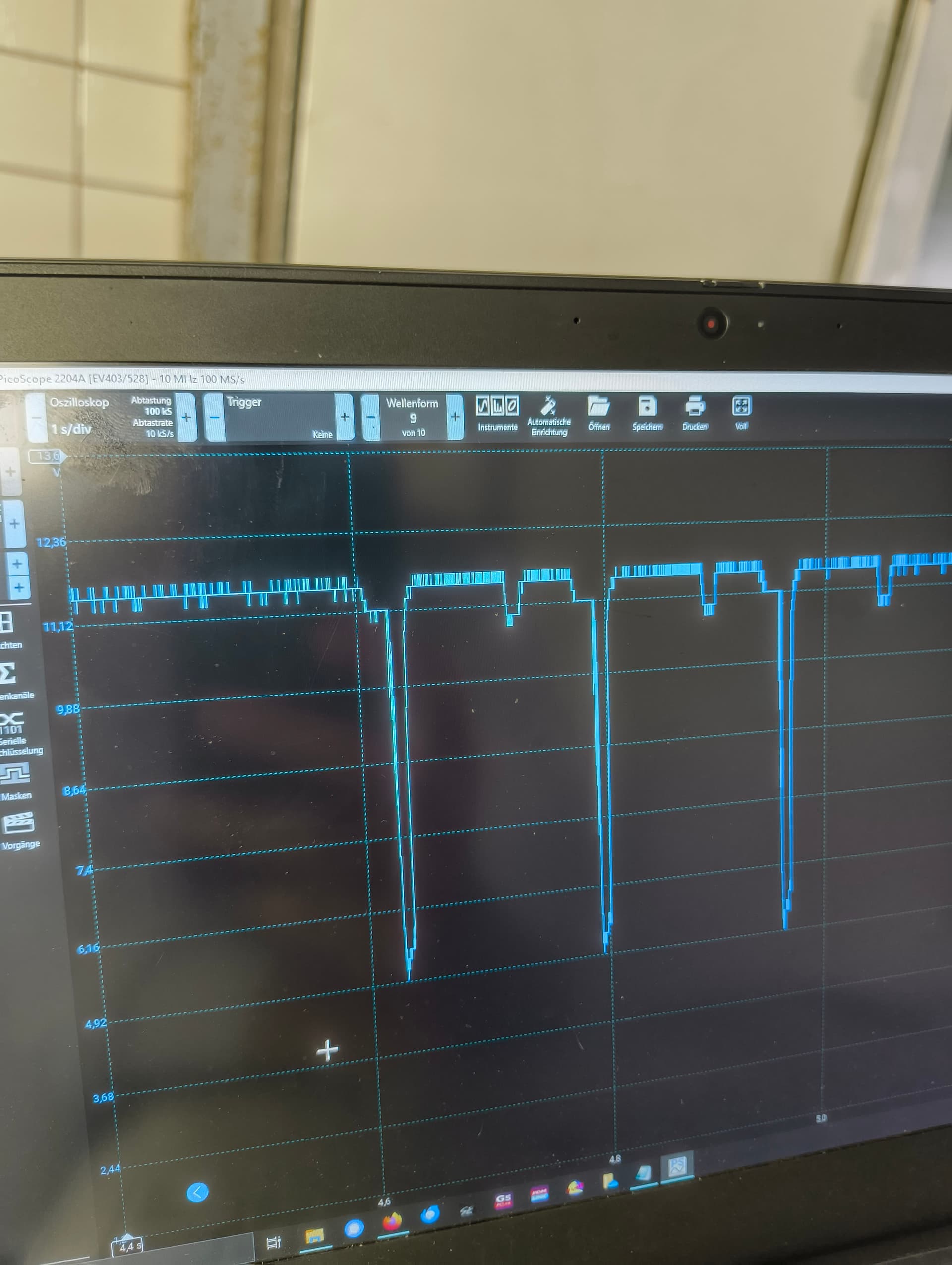
When you say ‘starter,’ do you mean the starter solenoid or the actual starter? Even a small starter can easily draw over 100 A.
Overall, it appears that the device resets due to a voltage drop. If the supply voltage at the PMU drops below 6 V, it will switch off. The loads will turn off, the voltage will rise back, and the device will switch on again.
Why does it start even with uncharged battery when the starter motor is operated via an external relay?
My assessment: The current for the starter does not flow through the wiring to the PMU and therefore does not cause an additional voltage drop. Is that correct?
That’s possible, or the battery is too small for the starter.
Because the relay/starter is not interrupted when the voltage drops.
If PMU controls the starter relay:
You try to start the engine,
PMU enables the output and switches on the starter relay,
Starter current starts flowing and battery voltage drops,
When the voltage is too low, PMU switches off,
If PMU switches off, so does the starter relay output,
Starter is switched off, voltage rises, and PMU switches back on.
When you used an external relay, without PMU, to start the engine, your PMU still reset. But the reset PMU didn’t switch off the starter.
With the voltage drop you have on a charged battery, the PMU should stay on, but it might be very close to resetting. A bit more discharged battery, or even a cold starter, can put it over the threshold of not starting up.