I was making a series of WOT pulls when this hesitation occurred. All other WOT pulls were good.
Any idea what could cause the VE to bounce when TPS is constant 100% and RPM is only slightly changing? For 100 % TPS and RPM > 3000 the VE 1 table has VE > 90%.
Using V3.054
Log showing VE low and bouncing from high 30s to low 90s. Lambda is high throughout.
The engine has ITBs, but has been street driven, dyno tuned and driven on track. This stuttering at WOT is not typical.
There is a 2nd wideband with its own controller (signal brought in as a 0-5 V analog). They don’t match exactly, but the overall movement is the same. Both Lambdas shown here:
Can you get it to replicate this every time? Possibly getting some noise in your wideband signal? Usually I would suspect faulty MAP signals for poor fuel tuning with ITBs. However yours looks pretty solid throughout both pulls. However one pull does read 100kpa and the other 97kpa. Do you have STFT on? If so is it even functioning in this situation?
I also notice that your IAT stays exactly flat during the whole run. Are you utilizing it at all anywhere? Does it have control over your fuel tables if not?
It doesn’t happen every time or even happen often. Sometimes I get a short stutter when opening the throttle in the mid RPM range. This is the only episode of this particular behavior where there is an extended series of stuttering. I have made numerous WOT pulls with no issues.
I’m not sure MAP is an issue. My fueling type is “Alpha-N with MAP multiplication and MAP-based ignition”. I originally had Alpha N (TPS-based), but my tuner changed it when the engine was dynoed in August.
What could cause misfiring? Are you suggesting a component issue or something in the ECU settings? FYI, I have a twin plug set-up with COPs. The upper plug circuit is separate from the lower plugs. They have separate power relays and separate ground connections.
IAT is 25C at startup. For most of the run it is 38-43C. The sensor is in the air cleaner box, not in a manifold.
Can you explain the VE values in the log? The TPS is 100% so VE should be >90% (see table above), yet VE is jumping around mostly in the 40-60% range. How can this happen when TPS is 100%? Besides TPS and RPM, what determines the VE lookup?
I missed the comment about detonation. There’s a Bosch knock sensor in each bank of cylinders (flat 6). The stuttering happens in the highlighted region. There’s no knock response shown.
Misfire sounds like a good candidate. I understand the concept of ignition dwell, but have no experience tuning it.
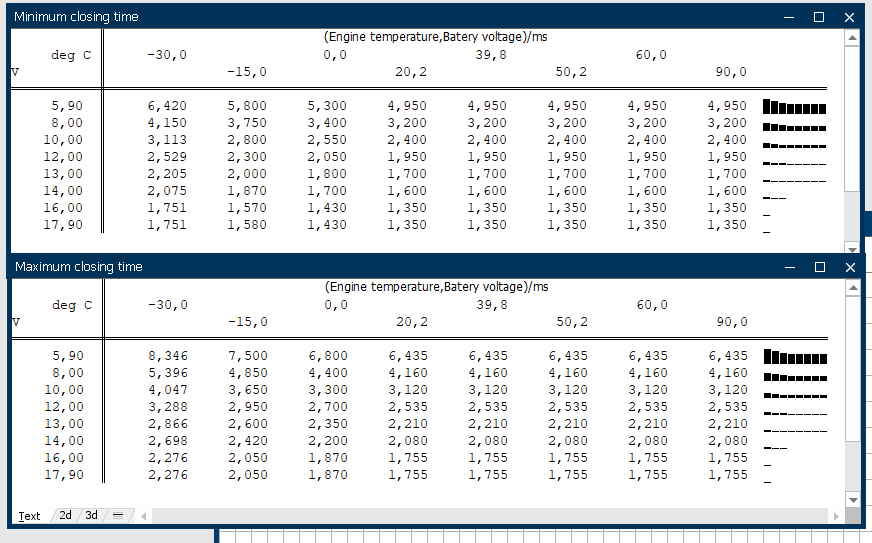
Here’s my current dwell table. I thought I set it up using the wizard early in the project. but the low voltage dwell values are clearly wrong. Values in the vicinity of 14 V are reasonable, but I don’t know what is required for my COPs. The COPs are Bosch 0 986 221 024, originally used in 4 cylinder Audis (and others, probably). The battery voltage is in the range 13.1 - 14.0 during the stuttering.
The upper and lower COPs have separate power and ground circuits. The trigger wire for each cylinder is shared between the upper and lower plugs. I’m running full sequential fuel and spark.
This log shows the dwell and battery voltage during the stuttering.
Google search came up with the following for the Audi COPs. These are higher than my existing settings at low voltages, but lower at high voltages. Slightly lower than mine around 14V. Anyone have specs for these COPs?
I found this data for similar COPs posted elsewhere on this site (thanks, J2performance). Apparently these values were reverse engineered from a stock ECU. Looks like engine temperature is not a factor above 20C. I live in a warm climate so “cold” starts aren’t very cold.
I took the max dwell values and interpolated to get entries for the dwell time table. This is a big improvement over what I had, but the dwell times at 13-14V are less than what I had before.
Jadzwin suggest more dwell and higher VE in the mid-range. I’ll try that next.
Even though this is for boosted operation, I may try it. Apparently the values are safe with the COPs I’m using. The high dwell values are only at low battery voltage, which would occur only during cranking.
I’ll install the dwell table as above and also richen up the mid-range per your previous suggestion. Unfortunately I could never reproduce the problem consistently, so testing is not going to give a definitive answer. If do have the problem again, I’ll bump up the dwell values a little and re-test. Thanks.
Whats your injector duty doing at those points? I was having radically high VE with Lambda correcting for lack of fuel pressure (yet I had enough injector to keep fuel up to it). It would only happen sometimes as well, pending on the circumstances for the pull. Low/high gear.
Changed out the fuel pump and things radically improved. If your injectors are above 90% you could be having erratic fuel delivery at top end. Bad spray pattern as the injectors might not be closing properly/fully.
Injector PW is moving in sync with VE (I’m still not sure why VE swings so much over a limited RPM range). Duty cycle is not near limit. Effective fuel pressure is very steady (note expanded scale). No short term trim running.
Injectors are not stock (original fuel injection was mechanical and did not use solenoid type injectors).
I’m thinking this is an ignition problem. Misfires resulting in unburned fuel leave oxygen in the exhaust stream and cause high Lambda readings, even if the amount of fuel is correct. I’m going to rework my ignition dwell table per Jadzwin and see what happens. I can’t reliably reproduce the problem, so testing may not be conclusive.